
Delivery
Staff augmentation vs outsourcing
These two get used as synonyms and they are not. One adds people to a team you run. The other hands a whole outcome to somebody else. Picking the wrong one is where most vendor relationships go wrong.
By Umar HayatChief Technology Officer, Algo Vortex
Key takeaways
The difference is who manages
Augmentation gives you people and leaves management with you. Outsourcing gives you an outcome and takes management away.
Augmentation needs your process to exist
If you have no backlog, no architecture, and no lead, adding engineers makes things worse rather than faster.
Outsourcing needs a definable outcome
You can hand over something with a clear finish line. You cannot hand over a direction and expect a product.
The dedicated team sits in between
A stable squad with its own lead, working your roadmap. It is the shape most long engagements converge on.
What is the actual difference?
Staff augmentation means you add engineers to a team you already run. They work in your repositories, attend your standups, take tickets from your backlog, and are reviewed by your leads. You are buying capacity. The management, the priorities, and the technical direction stay with you, and so does the responsibility if the thing does not work.
Outsourcing means you hand over an outcome. A vendor takes a defined scope, brings their own management and process, and delivers something at the end. You are buying a result rather than hours. You give up day-to-day control and in exchange you stop having to provide it.
The reason this distinction matters so much is that each model fails in a specific way when it is misapplied. Augmentation applied to a team with no direction produces expensive confusion, because you have added capacity to something that was never capacity-limited. Outsourcing applied to a vague ambition produces something nobody wanted, because the vendor had to guess at the parts you never specified.
The two models on the lenses that actually decide it
Lens
You buy
Staff augmentation
Capacity, by the person
Outsourcing
An outcome, by the scope
Lens
Who manages
Staff augmentation
You
Outsourcing
The vendor
Lens
Whose process
Staff augmentation
Yours
Outsourcing
Theirs
Lens
Whose repos
Staff augmentation
Yours
Outsourcing
Often theirs until handover
Lens
Needs from you
Staff augmentation
Backlog, lead, architecture
Outsourcing
A clear definition of done
Lens
Fails when
Staff augmentation
You have no direction to give
Outsourcing
The outcome was never definable
Lens
Ends how
Staff augmentation
People roll off
Outsourcing
Deliverable is accepted
| Lens | Staff augmentation | Outsourcing |
|---|---|---|
| You buy | Capacity, by the person | An outcome, by the scope |
| Who manages | You | The vendor |
| Whose process | Yours | Theirs |
| Whose repos | Yours | Often theirs until handover |
| Needs from you | Backlog, lead, architecture | A clear definition of done |
| Fails when | You have no direction to give | The outcome was never definable |
| Ends how | People roll off | Deliverable is accepted |
When does staff augmentation fit?
When you know exactly what to build and you do not have enough hands. The backlog is groomed, the architecture is decided, someone owns the technical direction, and the constraint is throughput. Adding engineers to that situation works immediately and predictably.
When you need a specific skill for a defined stretch. A mobile release, a cloud migration, a stretch of test automation, a security remediation. You keep ownership of the system and rent the expertise for the period you need it.
When institutional knowledge has to stay with you. Because augmented engineers work inside your process and your repositories, what they learn is documented in your systems rather than in a vendor's. That is a real difference from outsourcing and it matters over a multi-year horizon.
The requirement is that you can actually manage them. If your existing team is already under-managed, adding people will surface that rather than solve it. Staff augmentation is the commercial path once you know this is the shape.
When does outsourcing fit?
When the outcome is definable and separable. A marketing site, a mobile app with a settled specification, an integration between two systems, a migration with a clear before and after. Something with edges, where you can tell whether it is done.
When you genuinely do not want to build the management capability. A company whose product is not software but which needs a piece of software built is often better served by handing it over than by learning to run an engineering team for one project.
When it is peripheral to what you do. Internal tools, one-off data work, and utilities that need to exist but do not need to be yours are reasonable things to hand over completely.
The requirement is a real definition of done, agreed in writing, with acceptance criteria you could argue in front of a stranger. Without that you have not outsourced a project, you have started a negotiation that will run for as long as the engagement does.
Where does the dedicated team model sit?
In between, and it is where most long-running engagements end up. A dedicated team is a stable group of people who work only on your product, with their own technical lead, following your roadmap. You set direction and priorities. They handle their own day-to-day management, hiring, and internal quality.
It solves the main weakness of each pure model. You are not providing all the management that augmentation requires, and you are not handing over direction the way outsourcing does. The trade is that you need enough sustained work to keep a squad busy, because you are paying for the team whether the roadmap is full or thin.
The practical marker is duration. Below about six months, augmentation or a scoped outsourced project usually fits better. Beyond that, a dedicated team stops re-learning your system every engagement and that continuity becomes the main source of value. The offshore development center guide covers how this is structured.
How do the commercials differ?
Augmentation is almost always time-based, billed monthly per engineer or hourly. There is no scope to argue about because there is no scope, only capacity. That makes it simple to administer and it means you carry the risk if the work takes longer than expected.
Outsourcing is usually fixed price or milestone-based, and the vendor prices the scope risk in. Expect a premium of roughly fifteen to thirty percent over the same work billed hourly, plus a change request process, because the vendor now has a boundary to defend. That is not vendor greed, it is what carrying the risk costs.
Dedicated teams are billed monthly for a fixed roster. Predictable, easy to forecast, and the thing to watch is utilisation. Paying for six engineers while the roadmap supports four is the standard way this model wastes money.
Notice periods matter more than day rates. Augmentation typically has short notice, thirty days or so, which is part of the point. Dedicated teams usually need sixty to ninety because the partner is holding employment risk. Read that clause before you compare prices.
How do you choose in one conversation?
Answer three questions honestly. Do you have a groomed backlog and someone who owns technical direction. Can you write down what done looks like for the thing you want. And is this work going to continue past six months.
Yes to the first, and augmentation is your model. No to the first but yes to the second, and a scoped outsourced project fits. Yes to the third and the engagement is going well, and you will converge on a dedicated team regardless of where you started.
If you answered no to the first two, the problem is not sourcing. You need to define the work before you buy anyone to do it, and a short digital strategy consulting engagement is a cheaper way to get there than discovering it four months into a build.
Whichever model you pick, name it in the contract. A large share of unhappy vendor relationships are actually one side buying augmentation while the other sells outsourcing, and nobody noticing until something goes wrong and it turns out neither party thought they were managing it.
Next step
Not sure which model you are actually buying?
Tell us what state the backlog is in, who owns technical direction, and how long the work runs. We will say which shape fits, including when the answer is neither yet.
Talk to Algo VortexRelated in this cluster
- Offshore vs in-house developmentThe comparison boards usually run is a salary against an hourly rate, and it is the wrong comparison. Run the fully loaded number on both sides and the answer often flips.
- Dedicated development team costA dedicated team is a monthly bill, not a project quote. Here is what the common squad shapes cost, what the rate actually covers, and the clauses that change the number more than the rate does.
- How to choose a software development companyPick a partner who can ship a product you can keep, not a deck that names every stack. This filter is for custom software, SaaS, and CRM-shaped builds. AI-only buying has its own guide.
- Custom software developmentCustom software is the right call when a vendor tool forces awkward workarounds, or when your workflow is the product. This guide covers when to build, what an engagement includes, and how it differs from a template or a SaaS seat.
Related capabilities
Related case studies
Live products where this kind of work showed up in the build.
Twilio + OpenAI inbox automation
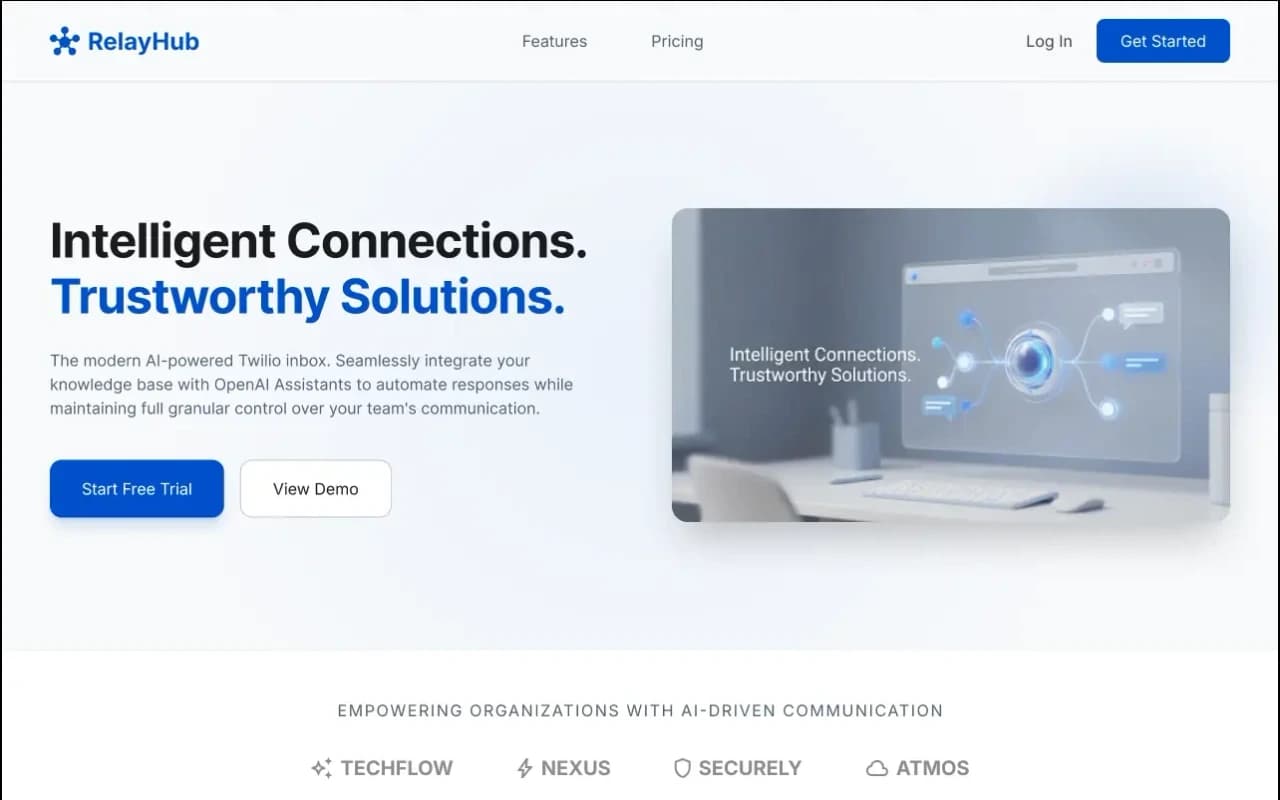
RelayHub started from a blunt observation: phone and chat should not live in separate tools. Sales and support kept losing the thread when a caller switched to SMS or a chat widget. The brief was one shared inbox. Twilio traffic and digital messages land together. AI clears the routine work so people only jump in when judgment matters. Teams also needed to steer the assistant without shipping a new build every time the script changed. Admin-controlled prompts per contact group were in the brief from day one. File digests mattered too. Long PDFs and call notes piled up unread. The product needed a path from upload to a short summary the whole group could scan before the next shift. Nobody on the project believed every reply should be fully automated. Refund fights, tone-sensitive replies, and messy exceptions still need a human. RelayHub uses OpenAI to draft, summarize, and clear the easy queue so senior staff spend time on work that actually needs them.
QuizQuest: practice that shows what you actually mastered
Timed quizzes + admin question creator
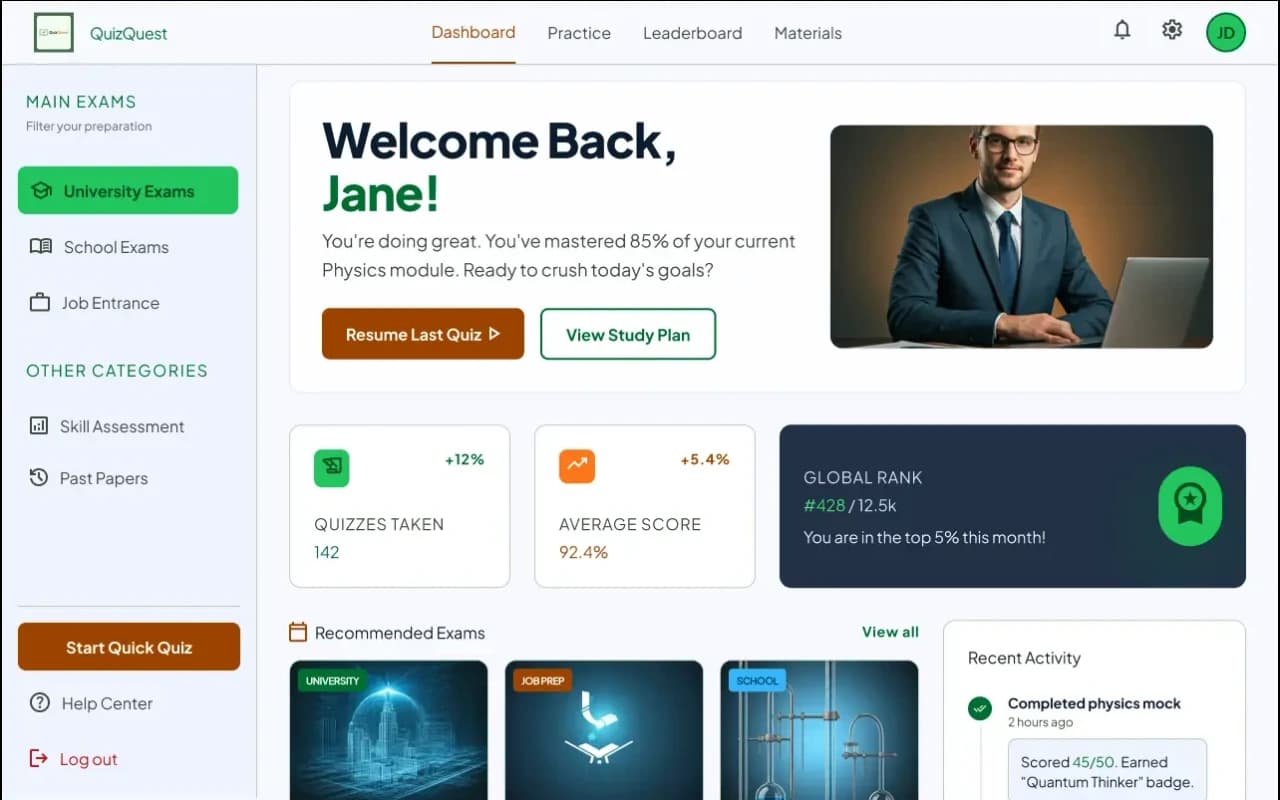
QuizQuest gives students timed practice with instant feedback and shows which topics they own versus which ones keep failing them. Instructors need a Question Creator that drafts and publishes assessments without another spreadsheet war or PDF email chain. The goal was assessment that teaches during the attempt, not only after a graded dump. Profiles should reflect mastery over time so learners and teachers can plan the next practice set from real attempt data, not from memory of last week's quiz. Schools and training programs wanted practice that survives real class periods. Timers have to hold up. Feedback has to arrive while the question is still fresh. Authoring tools have to be ones instructors will open twice a week. QuizQuest was built for that weekly rhythm, not for a one-off demo quiz. Instructors also needed confidence that a published quiz would look the same for every student in the room. That sounds basic until you mix diagrams, timers, and late joiners. Consistency was part of the promise.
Questions
More on all insights, AI development, or contact Algo Vortex.