
Delivery
Offshore vs in-house development
The comparison boards usually run is a salary against an hourly rate, and it is the wrong comparison. Run the fully loaded number on both sides and the answer often flips.
By Umar HayatChief Technology Officer, Algo Vortex
Key takeaways
Salary is not the cost
Recruiter fees, empty seat months, benefits, payroll tax, equipment, and attrition risk all belong in the in-house number.
Time to productive matters more than rate
A seat you fill in eight weeks beats a cheaper seat you fill in six months. Count the roadmap that slipped while you searched.
Own the core, partner on the rest
Keep the knowledge that is genuinely your advantage in-house. Everything else is a staffing question, not an identity question.
Overlap is the real constraint
Not quality, not language. The thing that decides whether offshore works is how many hours you actually share and whether you write things down.
What does an in-house engineer actually cost?
Salary is usually somewhere between sixty and seventy percent of what an in-house engineer costs a company. The rest is spread across lines that live in different budgets, which is exactly why it goes missing from the comparison.
Start with recruiting. A contingency recruiter typically takes fifteen to twenty-five percent of first-year salary, and even an in-house talent team has a real cost per hire. Then the seat sits empty while you search. Sixty to ninety days is normal for a mid-level engineer and longer for anything specialised. That empty seat has no invoice, which is why it never appears in a business case, and it is often the single largest cost in the whole exercise because it is roadmap time you cannot buy back.
Then add employer payroll taxes and benefits, which vary by country but commonly land between twenty and thirty-five percent on top of salary. Add equipment, software licences, and the share of office cost. Add ramp time, since a new hire is not fully productive for one to three months depending on the complexity of your system.
Finally, price the risk. Voluntary attrition in software sits in the mid-teens annually at most companies, so a portion of every hire is a repeat of this whole process next year. And a genuinely bad hire discovered at month six costs the salary paid, the recruiting fee, the manager time, and the work that has to be redone.
The lines that usually go missing from an in-house estimate
Cost line
Recruiting fee
Typical scale
15 to 25 percent of salary
Shows up where
One-off, often a different budget
Cost line
Empty seat
Typical scale
60 to 90 days of lost output
Shows up where
Nowhere, and it is the biggest one
Cost line
Payroll tax and benefits
Typical scale
20 to 35 percent on salary
Shows up where
Finance, not engineering
Cost line
Equipment and licences
Typical scale
$2,000 to $5,000 first year
Shows up where
IT budget
Cost line
Ramp to productive
Typical scale
1 to 3 months
Shows up where
Nowhere
Cost line
Attrition risk
Typical scale
Mid-teens percent annually
Shows up where
Next year's problem
| Cost line | Typical scale | Shows up where |
|---|---|---|
| Recruiting fee | 15 to 25 percent of salary | One-off, often a different budget |
| Empty seat | 60 to 90 days of lost output | Nowhere, and it is the biggest one |
| Payroll tax and benefits | 20 to 35 percent on salary | Finance, not engineering |
| Equipment and licences | $2,000 to $5,000 first year | IT budget |
| Ramp to productive | 1 to 3 months | Nowhere |
| Attrition risk | Mid-teens percent annually | Next year's problem |
What does the offshore side actually cost?
The offshore number is more honest because most of it arrives as one invoice. A monthly rate per engineer covers salary, employment costs, equipment, office, and the partner's overhead and margin. There is no recruiting fee and no empty seat, because filling the seat is the partner's problem rather than yours.
What the invoice does not cover is your own management time. Somebody on your side has to own the relationship, review the work, and answer questions. On a small engagement that is a few hours a week. On a larger one it is a real part of an engineering manager's job, and pretending otherwise is how offshore arrangements quietly fail.
There is also a ramp cost, and it is the same one you pay for a local hire. An offshore engineer learning your system takes the same one to three months a local engineer would. The difference is that you are not also paying for the two months before they started.
For current figures, offshore development rates in Pakistan covers the rate side and dedicated development team cost covers what a full squad runs to monthly.
When is in-house clearly the right answer?
When the knowledge is the advantage. If a system encodes something genuinely proprietary about how your business works, and the people who understand it are the reason you win, keep that in-house. Not because a partner would do it badly, but because the knowledge should not have a contract term attached to it.
When the work needs constant unstructured contact. Early product discovery, where the requirement changes after every customer conversation, moves faster with everyone in a room. Once the shape is settled, that stops being true.
When compliance or client contracts genuinely restrict it. Some regulated work and some enterprise agreements limit who can touch data and where. Check whether the restriction is real or assumed, because it often turns out to be a policy nobody has revisited, but when it is real it settles the question.
And when you are hiring one person. The overhead of setting up a partner relationship does not pay off for a single seat. Offshore economics work at three engineers and get better from there.
When does offshore clearly win?
When you need capacity faster than you can hire it. This is the most common real reason and it has nothing to do with cost. A roadmap that needs four engineers in six weeks is not a recruiting problem you can solve, and a partner can staff it because they already employ the people.
When the work is well understood but large. Migrations, integrations, test coverage, platform maintenance, and the long tail of features that matter but do not need your most senior people. This is genuine work and it does not need to sit next to you.
When you need a skill for a defined period. A mobile release, a cloud migration, a security remediation. Hiring permanently for a six-month need creates a problem in month seven.
When the budget is fixed and the ambition is not. This is where the rate difference does the work. The same money buys meaningfully more engineering, and if the alternative is not building the thing, the comparison is not close.
What does the hybrid model look like in practice?
Most companies that get this right end up hybrid, and the split is usually along ownership rather than along seniority. In-house holds architecture decisions, the parts of the system that are genuinely differentiating, and the relationship with the business. The partner holds delivery capacity on well-defined streams.
The pattern that works is one in-house technical lead per offshore stream. That person owns the outcome, reviews the important pull requests, and is the single place questions go. Without it you get a team waiting on answers, which is the most expensive failure mode available because you are paying for people to be blocked.
The pattern that does not work is splitting one feature across both sides. Coordination cost on a shared feature exceeds the rate saving, every time. Give each side whole slices with clear interfaces between them.
An offshore development center is the durable version of this once the arrangement is working: a stable unit that follows your process rather than a new team assembled per project.
What actually determines whether offshore works?
Overlap hours, and honesty about them. US East and Pakistan share nothing on two standard nine to five days, so somebody shifts or you get a one-day round trip on every question. UK and Pakistan already share three to four hours without anyone moving. Those are different situations and they need different plans. The timezone overlap planner gives you the real number for your pairing.
Written practice, which the overlap constraint forces on you and which turns out to be good for everyone. Decisions in a document rather than a call. Specs that survive being read by someone who was not in the room. Recorded walkthroughs instead of live demos. Teams that build this habit run better even when everyone is in one office.
Continuity of people. The economics of offshore assume the team learns your system and keeps that knowledge. If the partner rotates engineers every quarter you pay the ramp cost repeatedly and never get the benefit. Ask about tenure and put named people in the statement of work.
And a real owner on your side. Every failed offshore engagement has the same root cause, which is that nobody internal was accountable for it. That is not a vendor selection problem and no partner can fix it for you.
Next step
Want the comparison run on your numbers?
Send the roles you are trying to fill, your location, and the roadmap they are meant to serve. We will lay both options out honestly, including when hiring locally is the better call.
Talk to Algo VortexRelated in this cluster
- Staff augmentation vs outsourcingThese two get used as synonyms and they are not. One adds people to a team you run. The other hands a whole outcome to somebody else. Picking the wrong one is where most vendor relationships go wrong.
- Dedicated development team costA dedicated team is a monthly bill, not a project quote. Here is what the common squad shapes cost, what the rate actually covers, and the clauses that change the number more than the rate does.
- Offshore development rates in PakistanHourly rates from Pakistan sit well below Western markets and slightly below India. Here are the 2026 ranges by role and seniority, why the spread is so wide, and what a rate at the very bottom usually means.
- How to choose a software development companyPick a partner who can ship a product you can keep, not a deck that names every stack. This filter is for custom software, SaaS, and CRM-shaped builds. AI-only buying has its own guide.
Related capabilities
Related case studies
Live products where this kind of work showed up in the build.
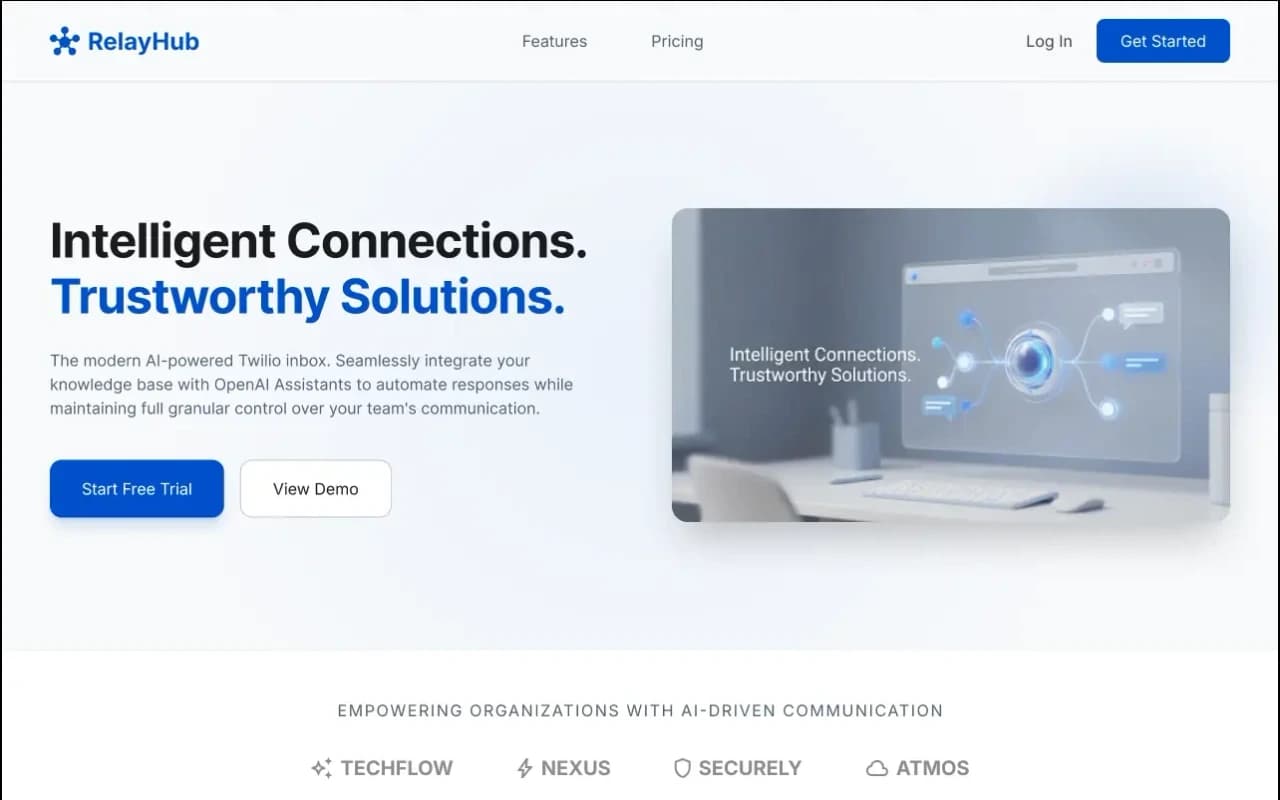
Twilio + OpenAI inbox automation
RelayHub started from a blunt observation: phone and chat should not live in separate tools. Sales and support kept losing the thread when a caller switched to SMS or a chat widget. The brief was one shared inbox. Twilio traffic and digital messages land together. AI clears the routine work so people only jump in when judgment matters. Teams also needed to steer the assistant without shipping a new build every time the script changed. Admin-controlled prompts per contact group were in the brief from day one. File digests mattered too. Long PDFs and call notes piled up unread. The product needed a path from upload to a short summary the whole group could scan before the next shift. Nobody on the project believed every reply should be fully automated. Refund fights, tone-sensitive replies, and messy exceptions still need a human. RelayHub uses OpenAI to draft, summarize, and clear the easy queue so senior staff spend time on work that actually needs them.
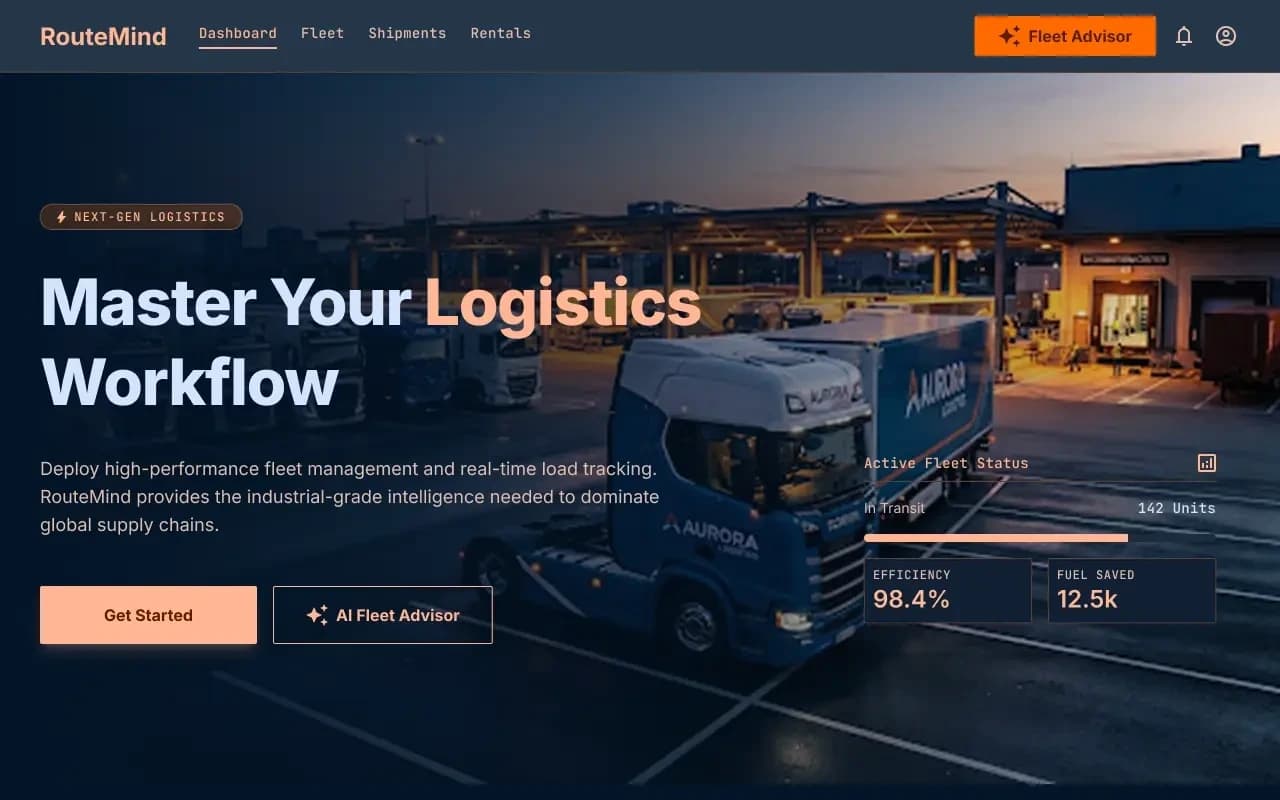
RouteMind: fleet dispatch that cuts empty miles
AI fleet advisor + live load board
RouteMind exists so shippers and carriers can see loads, capacity, and routes in one place. Dispatch should cost less time and fewer wasted miles. The product pairs a live load board with an AI Fleet Advisor. Planners match freight to available trucks and compare paths with real map data instead of gut feel. Empty miles and stale boards were the business pain. When capacity is a guess, trucks deadhead and fuel burns for no revenue. Status, distance, and advisor guidance had to show up in the tools dispatchers already live in. Another spreadsheet export at the end of the shift was not going to cut it. Dispatchers needed advice that respected current capacity, not a generic logistics chatbot. The Fleet Advisor had to read live loads and vehicle state, then suggest moves a planner could accept or reject in the same UI. RouteMind was never meant to replace judgment. It was meant to cut the time spent assembling the picture before judgment starts.
Questions
More on all insights, AI development, or contact Algo Vortex.