
Delivery
Offshore development rates in Pakistan in 2026
Hourly rates from Pakistan sit well below Western markets and slightly below India. Here are the 2026 ranges by role and seniority, why the spread is so wide, and what a rate at the very bottom usually means.
By Umar HayatChief Technology Officer, Algo Vortex
Key takeaways
$20 to $45 an hour covers most of it
Mid-level to senior engineering from an established Pakistani firm sits in that band in 2026. Specialists go higher.
The spread is about the seller, not the country
A freelancer, a small studio, and an established firm quote very differently for the same skill. Compare like with like.
Rate is a poor proxy for cost
Total cost follows rework and coordination. A team at half the rate that redoes a quarter of the work is not half the price.
Below $15 buys something else
At that level something is missing: seniority, testing, or the assumption that the person is employed rather than subcontracted.
What are offshore development rates in Pakistan in 2026?
For an established Pakistani software firm employing its engineers full time, hourly rates in 2026 generally run as follows. Junior engineers sit around $18 to $25. Mid-level engineers run $22 to $35. Senior engineers run $32 to $50. Tech leads and architects run $45 to $70. QA engineers sit at $15 to $28 and product designers at $22 to $40.
Specialised skills carry a premium that is larger than most buyers expect. AI and machine learning engineering commonly runs $45 to $75, and platform or site reliability engineering $35 to $60. The supply of genuinely experienced people in those areas is thin everywhere, and Pakistan is no exception.
Most engagements convert to monthly rather than hourly, which is usually the better basis because it removes the incentive to bill hours rather than deliver outcomes. Dedicated development team cost covers the monthly figures by role and squad shape.
These ranges assume a firm with a legal entity, employed staff, and someone accountable for delivery. Freelance marketplaces run considerably lower and the difference is not a discount, it is a different product with different risk.
Pakistan hourly rates, 2026, USD, established firm
Role
Junior engineer
Hourly range
$18 to $25
Notes
Needs supervision, fine for well-defined work
Role
Mid-level engineer
Hourly range
$22 to $35
Notes
The core of most squads
Role
Senior engineer
Hourly range
$32 to $50
Notes
Owns a domain end to end
Role
Tech lead or architect
Hourly range
$45 to $70
Notes
Architecture and technical direction
Role
QA engineer
Hourly range
$15 to $28
Notes
Manual and automation
Role
Product designer
Hourly range
$22 to $40
Notes
UX and UI
Role
DevOps or SRE
Hourly range
$35 to $60
Notes
Often shared across projects
Role
AI or ML engineer
Hourly range
$45 to $75
Notes
Thin supply, real premium
| Role | Hourly range | Notes |
|---|---|---|
| Junior engineer | $18 to $25 | Needs supervision, fine for well-defined work |
| Mid-level engineer | $22 to $35 | The core of most squads |
| Senior engineer | $32 to $50 | Owns a domain end to end |
| Tech lead or architect | $45 to $70 | Architecture and technical direction |
| QA engineer | $15 to $28 | Manual and automation |
| Product designer | $22 to $40 | UX and UI |
| DevOps or SRE | $35 to $60 | Often shared across projects |
| AI or ML engineer | $45 to $75 | Thin supply, real premium |
Why is the range so wide for the same title?
Because the title is the least informative thing in the quote. Four factors explain most of the spread, and none of them is geography.
Who you are buying from is the largest. A freelancer on a marketplace has no employment cost, no office, no bench, and no management overhead, so they can quote at ten to fifteen dollars and still earn well. An established firm carries all of those and has to price them in. What you get for the difference is continuity, replacement cover, a legal counterparty, and someone whose job is to notice when a project is going wrong.
Actual experience is second, and titles inflate. Five years of building similar systems is a different thing from five years of assorted work, and it shows up in architecture decisions rather than in typing speed. Read a code sample and talk to the person rather than trusting the label on the proposal.
Engagement length is third. A long dedicated arrangement usually prices below a short project because the partner is not carrying bench risk between engagements. And engagement type is fourth: fixed price carries a risk premium of roughly fifteen to thirty percent over the same work billed hourly, because somebody has to own the scope risk and in that model it is the vendor.
How does Pakistan compare to other offshore markets?
Pakistan and India sit close, with Pakistan typically five to fifteen percent below comparable Indian firms. The difference is mostly market maturity rather than capability, and it narrows at the senior end where both markets compete for the same people.
Eastern Europe, meaning Poland, Romania, and Ukraine, runs meaningfully higher, commonly $40 to $80 an hour. The trade is timezone: those markets share a working day with Western Europe and a workable afternoon with the US East Coast. If overlap is your binding constraint rather than budget, that premium is buying something real.
Latin America runs $35 to $70 and exists almost entirely for US timezone alignment. For a US West Coast company the overlap advantage over South Asia is large enough that the rate difference is often justified.
The Philippines sits close to Pakistan on rate and is stronger on customer-facing and support-heavy work. For product engineering specifically, South Asia has the deeper bench.
Where Pakistan does well is the combination of rate, English-language working, and a large enough talent pool for real product engineering. Where it is weakest is US West Coast overlap, which is twelve to thirteen hours and genuinely difficult. The timezone overlap planner gives you the real number for your city.
Rough regional comparison, 2026, mid to senior engineering
Region
Pakistan
Typical hourly
$22 to $50
Main trade-off
US West overlap is hard
Region
India
Typical hourly
$25 to $55
Main trade-off
Similar, larger market
Region
Philippines
Typical hourly
$20 to $45
Main trade-off
Stronger on support than product engineering
Region
Latin America
Typical hourly
$35 to $70
Main trade-off
Best US overlap, higher rate
Region
Eastern Europe
Typical hourly
$40 to $80
Main trade-off
Best EU overlap, highest offshore rate
Region
US or Western Europe
Typical hourly
$100 to $200
Main trade-off
Same room, several times the cost
| Region | Typical hourly | Main trade-off |
|---|---|---|
| Pakistan | $22 to $50 | US West overlap is hard |
| India | $25 to $55 | Similar, larger market |
| Philippines | $20 to $45 | Stronger on support than product engineering |
| Latin America | $35 to $70 | Best US overlap, higher rate |
| Eastern Europe | $40 to $80 | Best EU overlap, highest offshore rate |
| US or Western Europe | $100 to $200 | Same room, several times the cost |
What does a rate below $15 actually mean?
It means something has been removed, and it is worth knowing what. Usually one of four things.
Seniority. The rate is real and the person is early-career. That is fine for well-defined work with a strong reviewer, and it is a poor idea for architecture or anything where a bad early decision compounds.
Testing and review. The quote covers writing code and not verifying it. This looks like a saving for one sprint and stops looking like one the first time something breaks in production that a test would have caught.
Employment. The person is a subcontractor rather than an employee, possibly working across several clients simultaneously. You have no continuity guarantee and no real recourse. This is common on marketplaces and it is not disclosed.
Or it is a loss-leader on the first engagement, with the rate rising at renewal once switching has become expensive. Ask what the rate will be in year two and get the answer in writing.
None of these is automatically disqualifying. All of them are things you want to know before comparing the number against a quote that includes them.
Why is rate a bad way to choose?
Because you do not buy hours, you buy working software, and the conversion between the two varies enormously. A senior engineer at fifty dollars who solves something correctly in two days costs less than a junior at twenty who takes two weeks and produces something that has to be revisited.
Rework is the largest hidden cost in offshore delivery and it never appears in a rate comparison. Neither does coordination overhead, which grows when a team needs more supervision. Neither does the cost of a decision made badly early, which surfaces as a rewrite eighteen months later.
The useful comparison is cost per delivered outcome, and the only honest way to get at it before committing is a small paid slice. One real feature over two to three weeks in your repository tells you the actual conversion rate from money to software for that specific team. It costs a fraction of the project and it is the single most informative thing you can buy.
How to choose a software development company covers the rest of the diligence, and custom software development cost covers project-level bands rather than rates.
Next step
Want a rate card for the roles you need?
Send the skills and the seniority you are after. We will send per-role rates, say where a cheaper mix would do the job, and where it would not.
Talk to Algo VortexRelated in this cluster
- Dedicated development team costA dedicated team is a monthly bill, not a project quote. Here is what the common squad shapes cost, what the rate actually covers, and the clauses that change the number more than the rate does.
- Offshore vs in-house developmentThe comparison boards usually run is a salary against an hourly rate, and it is the wrong comparison. Run the fully loaded number on both sides and the answer often flips.
- Custom software development costCustom software in 2026 lands in bands, not a single quote. The build, hosting, and the people who keep it all show up. Here is how those numbers typically break for a first production version.
- How to choose a software development companyPick a partner who can ship a product you can keep, not a deck that names every stack. This filter is for custom software, SaaS, and CRM-shaped builds. AI-only buying has its own guide.
Related capabilities
Related case studies
Live products where this kind of work showed up in the build.
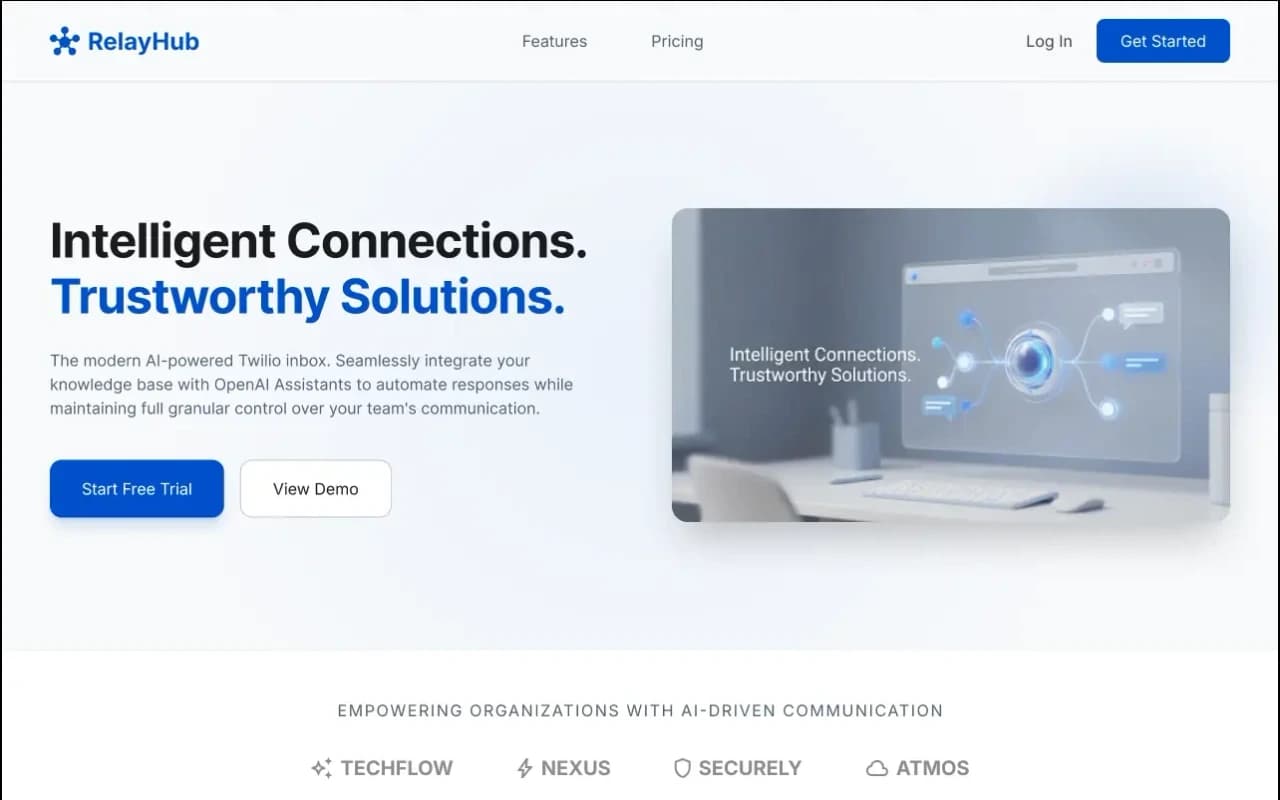
Twilio + OpenAI inbox automation
RelayHub started from a blunt observation: phone and chat should not live in separate tools. Sales and support kept losing the thread when a caller switched to SMS or a chat widget. The brief was one shared inbox. Twilio traffic and digital messages land together. AI clears the routine work so people only jump in when judgment matters. Teams also needed to steer the assistant without shipping a new build every time the script changed. Admin-controlled prompts per contact group were in the brief from day one. File digests mattered too. Long PDFs and call notes piled up unread. The product needed a path from upload to a short summary the whole group could scan before the next shift. Nobody on the project believed every reply should be fully automated. Refund fights, tone-sensitive replies, and messy exceptions still need a human. RelayHub uses OpenAI to draft, summarize, and clear the easy queue so senior staff spend time on work that actually needs them.

Loom & Luxe: rent the dress, skip the full retail bill
Rentals, deposits, and return logistics
Loom & Luxe makes designer dresses reachable for short events. Shoppers browse an editorial catalog, book a rental window, pay a fraction of retail, and get pickup handled when the window closes. Owners and brands need inventory, active rentals, and earnings in one lender dashboard instead of side chats and spreadsheets. The business needed rental commerce that feels like shopping, not a form dump. Deposits, delivery addresses, and returns had to be productized. If those steps stay manual, the marketplace cannot grow past a handful of garments and a very patient ops person. Trust sits at the center. Renters need deposits and holds that feel fair. Lenders need payouts and inventory status they can verify. Both sides had to feel comfortable putting real garments and real event dates into the system, not treating it like a weekend experiment. The storefront had to feel like fashion retail while the backend behaved like a logistics system. Pretty pages without return automation fail. Automation without an editorial catalog fails too. That tension is the real product.
Questions
More on all insights, AI development, or contact Algo Vortex.